Heat pump noise: what sound insulation?
Hello everyone, Benjamin here. To reduce the noise from a heat pump, first address its location and vibrations, then have a compatible acoustic screen or enclosure assessed if necessary. Good thermal insulation does not guarantee quiet: sound insulation, transmission through mounting points, and disturbance to neighbors are separate issues.
WHAT TO DO FIRST
- Identify whether the disturbance comes from airborne noise, vibrations, or unusual mechanical noise.
- Choose a heat pump suited to the required capacity to avoid oversizing.
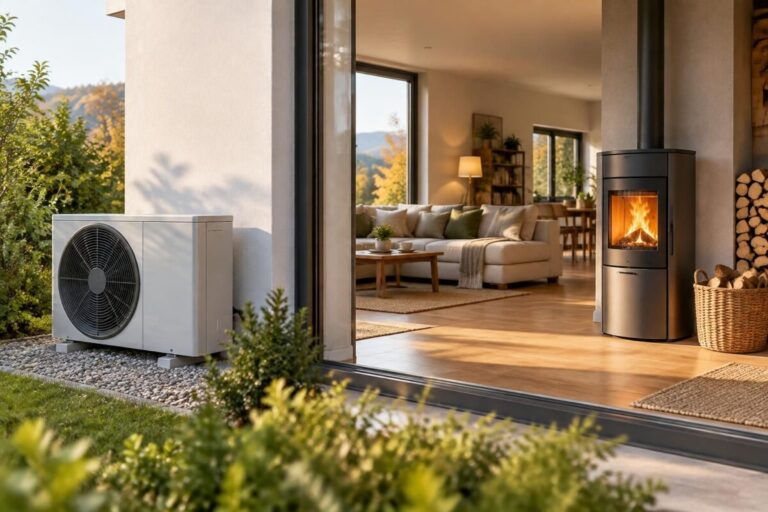
- Install the outdoor unit away from windows and wall corners to prevent reverberation.
- Use anti-vibration pads to limit transmitted vibrations.
- Have the quiet mode and its ability to maintain heating checked, without expecting the noise to disappear.
Thermal insulation and soundproofing: what’s the difference?
Thermal insulation limits heat loss; sound insulation reduces sound transmission. One cannot infer the performance of one from the other. The fan and compressor can produce airborne noise, while mounts and pipes transmit vibrations through the structure. Identify the path the noise takes before buying a solution.
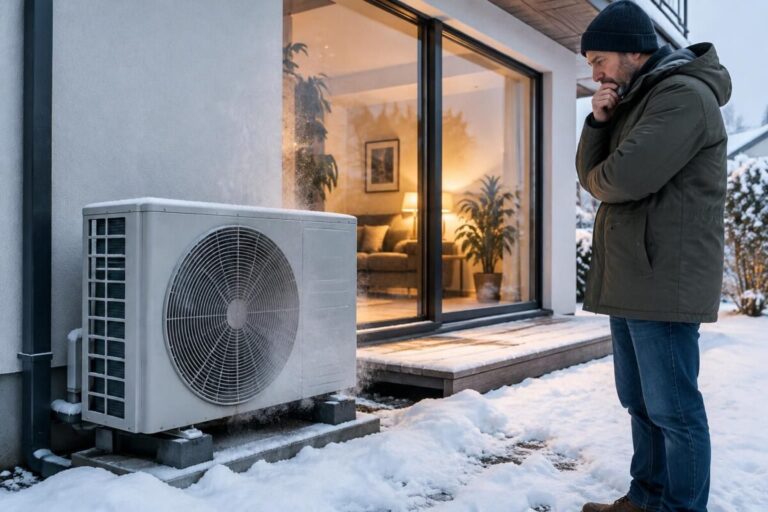
If you mainly hear a whooshing sound near the window, the location and propagation through the air should be examined. If a humming sound is transmitted to a wall or floor, have the mounts and connections checked. If a clanking or new noise appears, start with a maintenance diagnosis. A phone app can help you note when the noise occurs, but it is no substitute for a professional acoustic measurement.
How to improve the sound quality of the installation
We recommend:
- Move the heat pump installation away from windows and avoid corners or walls that act as a sounding board.
- Place the heat pump on anti-vibration pads to limit vibrations transmitted to the ground and walls.
- Have a professional design a screen or enclosure, and verify airflow and the clearances specified by the manufacturer.
- Choose a model with a night (quiet) mode that reduces fan speed and compressor frequency when demand is lower.
- Carry out regular maintenance to prevent noise caused by worn or dirty parts.
Which acoustic solution is right for each type of noise?
| Disturbance observed | Cause to check | Solution to consider | Points to watch |
|---|---|---|---|
| Whooshing sound directed toward a window | Location and path of airborne noise | Relocation, repositioning, or acoustic screen | Avoid reflections and preserve clearances |
| Humming in a wall | Transmission through mounts or pipes | Suitable anti-vibration mounts and connections | Do not modify the mounts without a professional |
| Noise in several directions | Sound radiation from the outdoor unit | Compatible enclosure following an assessment | Ventilation, maintenance access, and heating performance |
| Noise that has appeared recently | Part, mount, fan, or obstruction | Diagnosis and maintenance | Do not conceal a fault with a cover |
3 simple steps for a successful installation
- Step 1: Note the times, rooms, and conditions in which the disturbance occurs, then have the installer identify its cause.
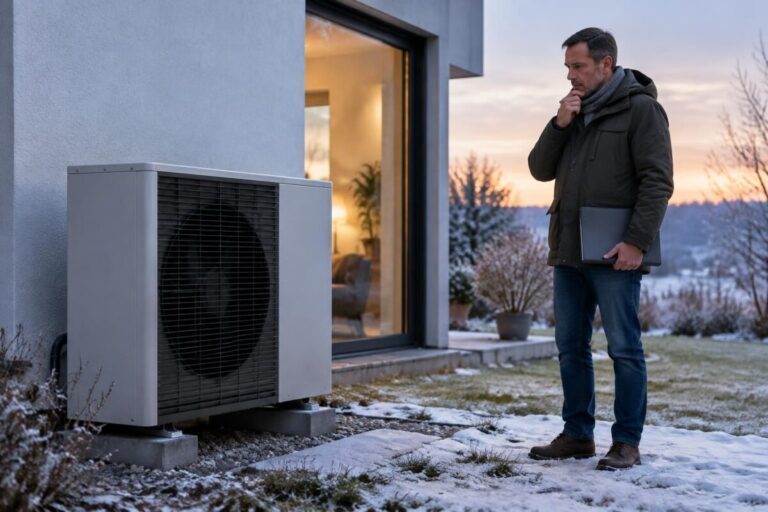
- Step 2: Have the unit’s location assessed in relation to windows, corners, bedrooms, and neighbors; a standard distance does not guarantee a good result.
- Step 3: Install noise-reduction devices such as anti-vibration pads and activate night mode if available; ensure regular maintenance to maintain acoustic performance.
What is the real impact on quality of life and energy performance?
Compare technical specifications under identical conditions. Sound power characterizes the source; sound pressure depends in particular on distance and the environment. A figure in dB(A) without specifying these conditions is insufficient. The AFPAC recommendations on siting and vibrations encourage planning for potential disturbance to occupants and neighbors from the design stage.
Thermal renovation can reduce heating needs, but it does not replace an acoustic assessment of the outdoor unit. To coordinate the work, also see heat pump or insulation: what should you upgrade first?.
Should you be concerned about noise when installing a heat pump?
Noise should be assessed before installation, without assuming that a refrigerant such as R-290 or inverter technology guarantees a quiet appliance. Compare the data for the exact model and the conditions of use. Never enclose the unit in a makeshift box: insufficient airflow can impair its operation. Have any acoustic treatment approved by the installer and the manufacturer.
Frequently asked questions
What is the noise standard for a heat pump in a residential area?
The rules address, in particular, neighborhood disturbance and, where applicable, sound emergence. Article R1336-7 of the French Public Health Code sets limits according to the time of day and applies corrections based on duration. This is not a universal noise limit measured one meter from the unit; have a professional assess the situation.
What distance should be maintained between the heat pump and the property boundary?
Do not rely on an automatic rule of 2 to 4 meters. Check the local urban planning rules (PLU), any condominium restrictions, and the expected acoustic outcome: distance alone does not guarantee there will be no nuisance.
How can you effectively reduce heat pump noise?
Moving the unit away from windows, placing it on anti-vibration pads, installing an absorbent acoustic screen, and activating night mode can significantly reduce perceived noise.
Can poor insulation increase noise?
A façade with poor acoustic performance may let more noise in. This cannot be inferred from its thermal insulation alone, and vibrations may travel along a different path through the structure.
Should I maintain my heat pump to limit noise?
Follow the system’s service schedule and the manufacturer’s instructions. A technician can check the fan, mounts, and supports; if the noise changes suddenly, request a diagnosis rather than waiting for the next service visit.
Thank you for staying with me until the end; Benjamin