
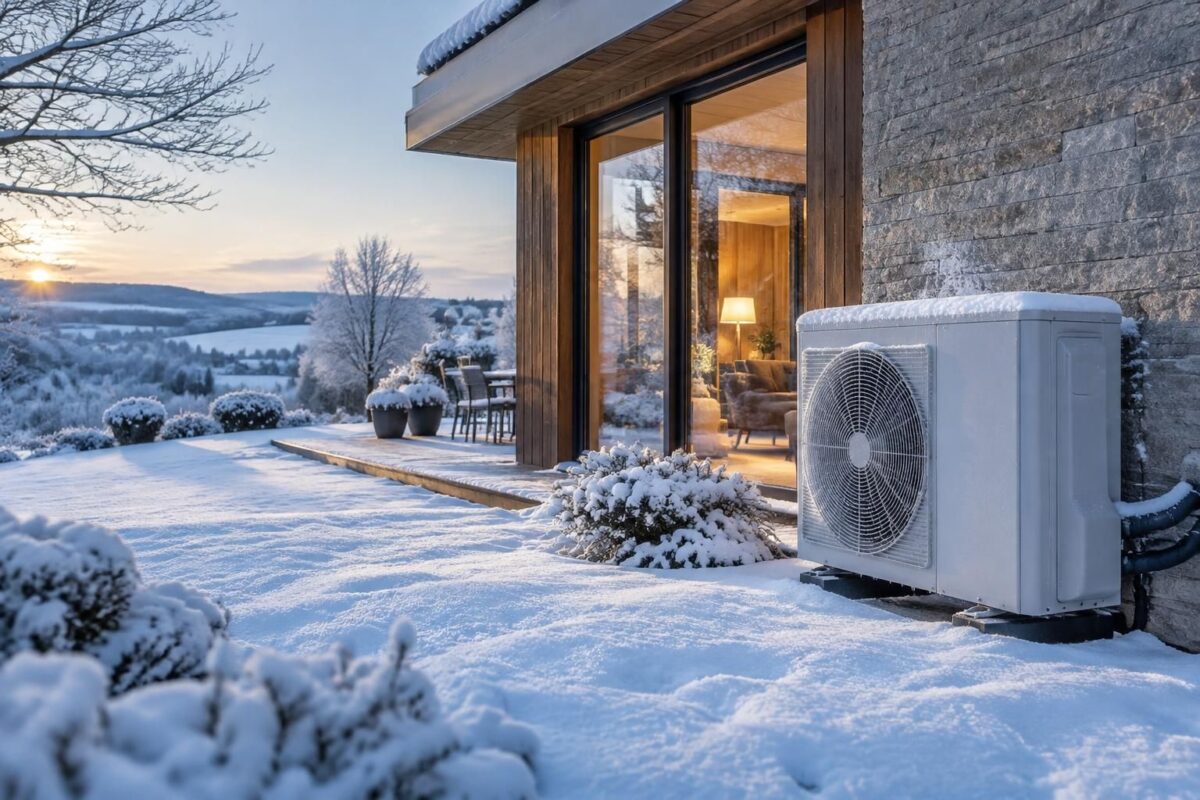
Energy-efficient heating: is the heat pump still effective in extremely cold weather?
Hello everyone, it’s Benjamin. Yes, an air-to-water heat pump can heat in very cold weather, but its efficiency decreases as the outside temperature drops. To maintain good comfort, the winning trio remains proper sizing, proper thermal insulation, and a well-adjusted auxiliary. Here are simple references to understand its thermal performance and avoid surprises in electricity consumption.
TO DO FIRST
- Check the sizing : ask for the planned power for your home and the base outdoor temperature for your region.
- Ask for the balancing temperature : it’s the threshold where the auxiliary heating can start to help the heat pump.
- Look at cold-weather performance on the technical sheet, not only the COP announced at mild temperature.
- Clear the outdoor unit of snow, leaves and anything blocking the air.
- Compare several RGE quotes and check what is planned for your radiators and your insulation.
How does a heat pump react to very cold weather?
A heat pump (air-to-water) recovers the calories present in the outside air and transfers them to the heating water. Even when it freezes, the air still contains energy; the machine can therefore continue to heat. However, the compressor must work harder to capture this heat.
The coefficient of performance (COP) expresses the ratio between heat produced and electricity consumed. With a COP of 3, the heat pump provides about 3 kWh of heat for 1 kWh of electricity. This figure varies depending on the model, the outside temperature and the water temperature requested by the radiators.
As a rough guide, a recent heat pump can display a COP around 3 to 3.5 near 0 °C, then around 2 to 2.5 toward -7 °C. Toward -15 °C, it may approach 1.5 to 2 depending on the model and installation. These are rough orders of magnitude, not a promise: consult the data that correspond precisely to your equipment.
| Outside temperature | Indicative COP of a recent heat pump | Takeaway |
|---|---|---|
| Around +7 °C | 4 to 4.5 | More favorable conditions for efficiency |
| Around 0 °C | 3 to 3.5 | The heat pump still provides several times the electricity consumed |
| Around -7 °C | 2 to 2.5 | The efficiency decreases, but is often still worthwhile |
| Around -15 °C | 1.5 to 2 | The auxiliary may become necessary depending on the dwelling |
A decrease in COP is therefore not a sign of failure. Electricity consumption increases especially if the cold lasts, if the house loses a lot of heat, or if the electric auxiliary heating runs for a long time. To better understand the gaps between promises and actual usage, also check this point on the real consumption of a heat pump.
Balancing temperature and heating assist: the real threshold to watch
The balancing temperature is the moment when the heat pump no longer covers all the needs of the home by itself. An integrated electric resistance can then supplement the heating. In a well-designed installation, this assist is mainly used during the coldest episodes, rather than operating all winter.
The threshold depends on the heat losses of the house, the local climate, the heat pump’s power and the emitters. It is often between -5 and -10 °C, but each situation is different. If the quote does not specify either the heat losses or the balancing temperature used, ask for explanations before signing.
Recent heat pumps can continue to operate at very low temperatures, sometimes around -20 °C or less depending on the model. This does not mean that they keep the same power or the same efficiency at all temperatures. The important point is to check the available power at cold temperatures, not just the minimum operating temperature.
Two scenarios to decide what to do
If your house is well insulated and equipped with underfloor heating, the heat pump can typically operate with cooler water, which favors its energy efficiency. A stable setting and a gradual rise in temperature also help avoid sudden power draws.
If your house is poorly insulated with old high-temperature radiators, the heat pump may end up delivering hotter water and lose efficiency. An assessment of heat losses, radiators and insulation work can then help prevent too frequent an auxiliary. This reference on the mistakes to avoid before installing a heat pump helps prepare the project.
The right actions for a more regular winter heating
An outdoor unit covered with snow or cluttered breathes poorly. Clear it without scraping the ice with a tool, and keep the space around it free. In cold and humid weather, a defrost cycle can produce steam or temporary noise: this is usually normal, but very frequent defrosts deserve a check.
Avoid also turning off the heating completely before requesting a strong temperature rise. A stable setpoint or a moderate drop at night often places less strain on the heat pump. Underfloor heating and low-temperature radiators are generally favorable; with conventional radiators, their compatibility should be checked.
- Set a regular temperature and avoid abrupt changes.
- Do not block the grilles and air intakes of the outdoor unit.
- Monitor how often the auxiliary heating is activated during cold waves.
- Have the settings and equipment checked according to the manufacturer’s recommendations.
A three-step method before winter
- Step 1 — Get the dwelling evaluated. Identify the main heat losses, the state of the thermal insulation, and the type of radiators or underfloor heating.
- Step 2 — Check the sizing. Ask the professional for the heat pump’s power at local cold temperatures, the heat loss calculation, and the balancing temperature.
- Step 3 — Prepare the piloting. Check the setpoints, the space around the outdoor unit, and the operation of the auxiliary heating before the first frosts.
If you compare devices, don’t stop at price or at a single COP value. Test conditions and home needs change the result a lot: this comparison of often-forgotten criteria can help you ask the right questions.
Frequently asked questions about a heat pump in extreme cold
From what temperature does a heat pump lose efficiency?
The drop in efficiency is gradual and becomes more noticeable when the outside temperature falls below about 5 to 7 °C. The threshold and performance depend on the model, the water temperature and the dwelling.
Does a heat pump stop when it freezes?
In general, no. Recent models continue to operate at negative temperatures, sometimes around -20 °C or less depending on the range. Their power decreases and an auxiliary heating may supplement the heating when needed.
Does the electric auxiliary heating necessarily raise the bill?
It consumes more than a heat pump in efficient operation. If it is used only during rare cold periods, its impact can remain limited; if it runs often, have the sizing, the settings and the heat losses of the dwelling checked.
Is a heat pump suitable for an old house?
It’s possible, but you need to check the heat losses, the radiators and the water temperature required. An improvement of the insulation or replacing certain emitters can sometimes improve comfort and efficiency.
In very cold weather, a well-chosen heat pump does not become useless: it works under less favorable conditions. Proper sizing and appropriate settings make all the difference to keep heating ecological, comfortable, and under control.
Thanks for sticking with us up to here; Benjamin