5 Ways to Save Energy with Better Heating
Hi, it’s Benjamin.
To save energy, adjust your heating settings, limit heat loss, and maintain your equipment before considering replacing it.
Energy-efficient heating doesn’t depend only on the appliance: settings and insulation matter just as much.
Here are five simple steps to improve your comfort without heating unnecessarily.
What to do now
- Schedule heating times to match your routine with a programmable thermostat.
- Aim for a suitable temperature: around 19 °C in living areas and 17 °C in bedrooms.
- Bleed your radiators if they make noise or stay cold at the top.
- Maintain your boiler and check the manufacturer’s instructions regularly.
- Reduce heat loss by closing the shutters at night and addressing drafts.
These steps are a good starting point before investing in a new appliance. To compare your options, explore the steps to try before changing your heating system and the criteria for an energy-efficient heating comparison.
Energy savings start with good settings
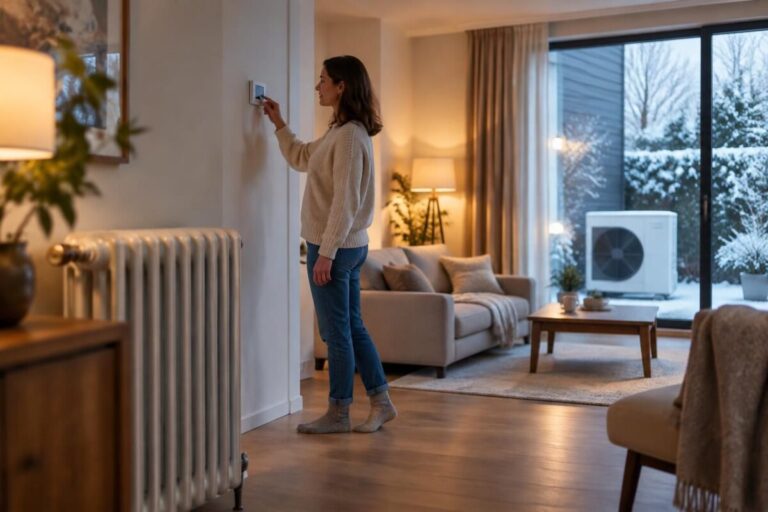
Camille often works outside the home and used to heat her home all day. By programming the thermostat to lower the temperature while she’s away, she avoids heating empty rooms and comes home to a comfortable house.
Lowering the thermostat by one degree can reduce heating consumption by around 7%, depending on the home and how it is used. The idea isn’t to feel cold: it’s to choose a temperature that suits each room and time of day.
Programmable thermostat and ideal temperature
A programmable thermostat lets you schedule heating periods and lower the temperature at night or when you’re away. Start with simple settings, then adjust them after a few days based on your comfort.
Avoid extreme changes: a moderate reduction is often enough. In a well-insulated home, heat is retained better, making it easier to adjust heating periods.
Thermal insulation and reducing heat loss
An efficient heating system can’t easily make up for poor thermal insulation. If air comes in through the windows or the attic is poorly insulated, some of the heat escapes before it can make your home comfortable.
Before replacing your equipment, identify cold spots: door bottoms, windows, and walls facing outdoors. Suitable seals or thick curtains can reduce some drafts, but targeted renovations may be needed to address the problem for good.
Low-energy radiators don’t deliver the same results in every home. Their efficiency depends in particular on insulation, sizing, and how you set the temperature.
| How to save | Useful action | What to watch for |
|---|---|---|
| Schedule heating | Match the schedule to when people are home | Avoid heating empty rooms |
| Set the temperature | Choose a temperature setting for each room | Don’t confuse comfort with overheating |
| Maintain the system | Have the boiler checked according to applicable regulations | Don’t ignore signs of a fault |
| Improve insulation | Address drafts and cold spots | Identify the main sources of heat loss |
| Optimize radiators | Bleed them if necessary and don’t block them | Allow air to circulate around them |
Boiler maintenance and bleeding radiators
A well-maintained system operates more reliably and can help prevent breakdowns during cold weather. For a boiler, follow the maintenance requirements that apply to your equipment and keep the certificate provided after the service visit.
Bleeding radiators is useful when they gurgle or don’t heat properly at the top. Let them cool down before doing this and follow your system’s instructions; if the problem returns, have the circuit checked rather than repeating the procedure without a diagnosis.
Smart heating: compare before replacing
Smart heating doesn’t necessarily mean installing a complex system. Programmable controls, properly adjusted thermostatic valves, and better insulation can already give you more precise control.
If your appliance is old or often breaks down, compare options based on the purchase price, energy source, maintenance, and the characteristics of your home. An appliance that looks appealing on paper may not suit a poorly insulated house or rooms that are rarely occupied.
Three steps to take before replacing your system
- Monitor your energy use and comfort: note cold rooms, heating schedules, and periods when you’re away.
- Adjust the settings and maintenance: program the thermostat, adjust the temperature settings, and have the system checked if necessary.
- Address heat loss before choosing an appliance: prioritize insulation, then compare equipment suited to your home.
This approach helps distinguish a settings issue from a genuine need for renovation. The best choice is the one that improves comfort while reducing energy consumption over the long term.
What temperature should you set in living areas?
A setting close to 19 °C is often suitable for living areas, while around 17 °C may be enough for bedrooms. Adjust these guidelines to your comfort, insulation, and whether people are at home.
When should you bleed radiators?
Bleed them if they gurgle or stay cold at the top. Do this when the radiator has cooled down and follow your system’s instructions.
Can a programmable thermostat really save energy?
It helps you match heating to when people are home and avoid heating unnecessarily. The savings depend on the settings, the home, and people’s habits.
Should you replace your boiler to reduce your bills?
Not necessarily. Start by checking the settings, maintenance, and thermal insulation. Whether to replace it depends on the condition of the equipment and the home’s needs.
Thanks for reading! Feel free to share your observations in the comments. — Benjamin