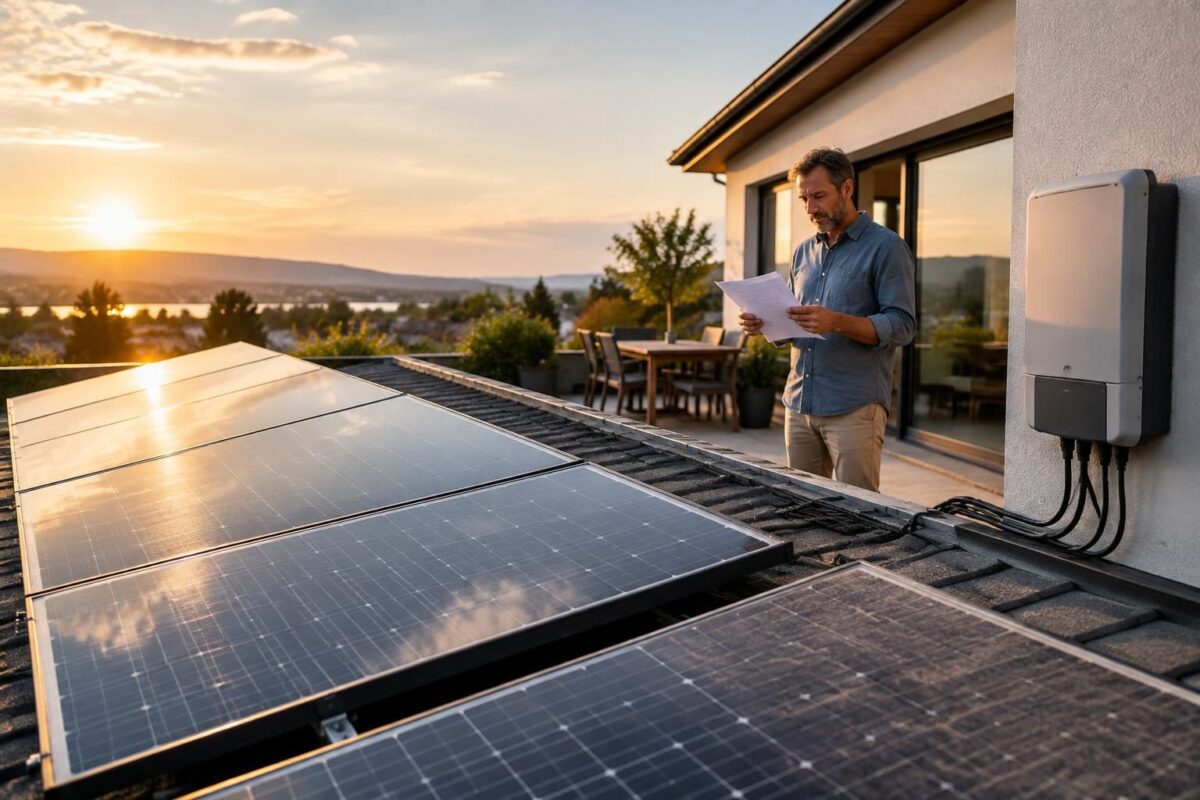
Solar energy: a good supplement or a false economy
Hello, Benjamin here.
Solar energy can be a good supplement if you use some of the electricity you generate and the installation cost fits your budget.
Photovoltaic panels don’t automatically guarantee energy savings: profitability depends mainly on your usage, sunshine levels and the installation price. A few simple checks can help you avoid a deal that seems good but isn’t.
Good habits to adopt
- Check your electricity use and identify when you use the most electricity.
- Request several detailed quotes, including the equipment, installation and any additional costs.
- Compare self-consumption with selling any unused electricity.
- Check what financial incentives are available and their conditions before factoring them into your calculations.
- Request a production estimate tailored to your roof’s orientation and pitch.
To assess whether solar makes sense with your heating system, also read our analysis of the combination of solar energy and a heat pump and our article comparing solar energy with an energy-efficient heating system.
Solar energy: a useful supplement or a disappointing investment?
It all depends on what you’re comparing. A system that meets some of your needs during the day can reduce the amount of electricity you buy, while a project sized without taking your usage into account may produce a lot of electricity at the wrong time.
Imagine Léa, who works from home and often runs her washing machine during the day. She can use some of the electricity she generates directly. Her neighbor, who’s away all day and has few appliances that can be used at different times, will need to rely more on selling electricity or consider a smaller system.
Compare installation costs with potential savings
Installation costs vary depending on the system’s capacity, roof configuration, equipment and labor. To compare offers, look at the total price as well as the estimated output, warranties and any maintenance costs.
Here are the main factors to consider before deciding that a project is profitable:
| What to compare | What to check | Why it matters |
|---|---|---|
| Installation cost | Itemized price, system capacity and included work | A clear quote makes it easier to compare installers. |
| Self-consumption | Share of the electricity generated that you use directly | Using the electricity you generate can increase your savings. |
| Electricity generation | Estimate based on your roof and local sunshine levels | A realistic forecast helps avoid overestimating the benefits. |
| Return on investment | Assumptions about prices, usage and electricity sales | The payback period depends on several factors and isn’t guaranteed. |
| Financial incentives | Eligibility and current rules | Incentives may change and should be confirmed before signing. |
A reliable profitability calculation distinguishes between electricity used on-site and electricity fed into the grid. It also takes possible changes in rates into account and doesn’t present a payback period as a certainty.
The trap of promises of quick returns
A common mistake is to accept a savings estimate without checking its assumptions. If the seller assumes high daytime electricity use when the home is empty, the promised savings may be too optimistic.
Ask for a simulation that specifies expected output month by month, the share you’ll use yourself and the terms for selling surplus electricity. Energy savings are more credible when they’re based on actual usage data rather than a sales promise.
Environmental impact matters too: generating renewable electricity can reduce your reliance on grid electricity, but the equipment, its manufacture and its end of life should also be considered. The best project is one that meets a real need and is suited to the home.
Three steps to decide whether photovoltaic panels are right for you
- Analyze your usage. Check your bills and identify appliances you can run during peak generation hours.
- Compare quotes. Check the proposed system capacity, total costs, warranties and production estimates.
- Recalculate cautiously. Include financial incentives only if you’re eligible, then compare the projected savings with the actual project cost.
If the numbers still look promising using cautious assumptions, solar energy can be a useful supplement. If the figures only work with exaggerated savings, it’s better to reconsider the system size or put the project on hold.
Frequently asked questions about solar energy and profitability
Are photovoltaic panels profitable everywhere?
No. Profitability depends in particular on sunshine levels, the roof, installation costs and the share of electricity used on-site.
Is self-consumption always better than selling electricity?
It can increase savings when your usage coincides with generation. However, compare the terms for selling electricity with your consumption profile before making a choice.
What financial incentives are available?
Programs and eligibility criteria may change. Check the official rules that apply to your project before signing a quote.
How can you avoid a false economy?
Request several detailed quotes and a realistic estimate of generation, self-consumption and the return on investment. Don’t rely solely on a promise of savings.
Thanks for reading! If this topic resonates with you, share your experience in the comments. — Benjamin