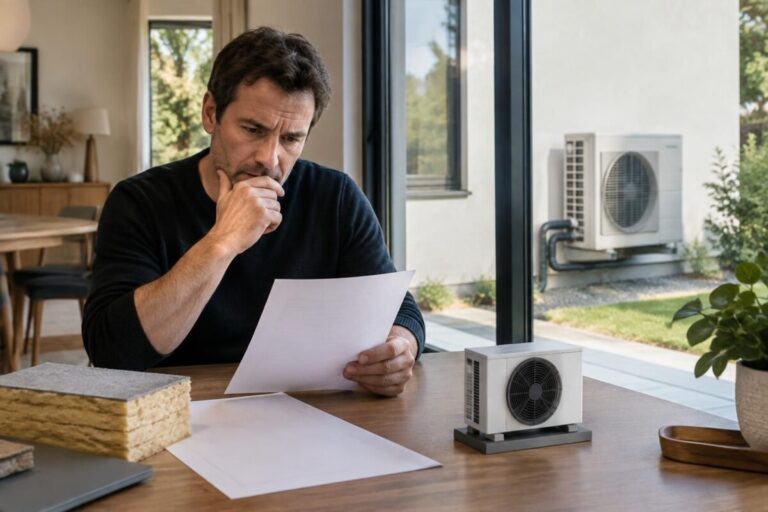
Low insulation: does the most economical heating…
Hi, it’s Benjamin.
With poor thermal insulation, no heating system alone can guarantee a low energy bill: reducing heat loss starts with insulation, followed by equipment suited to the home.
A heat pump can still be a good option, but it needs to be correctly sized and cannot make up for cold walls or poorly insulated attic spaces. The right approach is to compare heating costs over time without overlooking thermal comfort or the cost of the work.
Good habits for heating a poorly insulated home
- Identify the main sources of heat loss: attic spaces, walls, windows, and ground floors.
- Have the existing system checked before buying new equipment.
- Avoid oversizing the heating system to compensate for poor insulation.
- Compare the total cost: installation, energy use, maintenance, and available grants.
- Get several quotes and check the contractor’s qualifications before signing.
A common pitfall is to quickly replace a boiler with a more powerful unit: if heat is still escaping, energy use remains high. To compare options for different rooms, also see this guide to heating suited to each room and this comparison of heating systems that are worth considering.
Poor insulation: why economical heating is hard to find
In a poorly insulated home, some of the heat passes through the walls or escapes through air leaks. The heating system then has to run for longer to maintain the temperature, driving up the energy bill regardless of the fuel used.
A heat pump generally uses less electricity than electric resistance heating to produce the same amount of heat. But its efficiency can drop when the home needs a high temperature or the unit is not well suited to the property. So even high-performance equipment cannot eliminate heat loss from the building.
Heating costs also depend on the home
To compare options, you need to consider the floor area, local climate, temperature habits, and condition of the insulation. Two homes with the same system can have very different energy use, especially if one is exposed to the wind or has large, cold walls.
As a general guide, a heat pump can reduce electricity use compared with resistance heaters, but actual savings depend on usage and installation conditions. Low-energy radiators can improve temperature control in some rooms without reducing heat loss from the building.
| Option | Main advantage | What to watch for with poor insulation |
|---|---|---|
| Air-to-water heat pump | Suitable for an existing central heating system | Size it after assessing heating needs and heat emitters |
| Air-to-air heat pump | Often simpler to install when there is no hydronic circuit | Heat distribution and comfort vary depending on the layout |
| Wood or pellet stove | Can reduce use of central heating in a living area | Heat is distributed unevenly in homes with many enclosed rooms |
| Electric radiators | Low upfront investment and room-by-room control | Energy use can rise sharply if heating needs are high |
This table offers guidance, not a promise about your energy bill. The most economical choice depends on installation costs, energy prices, and the home’s actual level of performance.
Wall insulation and energy renovation: the factor that changes the calculation
When thermal insulation is poor, it is often better to reduce heating needs before replacing the equipment. Attic spaces and the roof deserve particular attention, followed by wall insulation, windows, and ground floors, depending on the home assessment.
A real-life example: in a house where the bedrooms stay cold despite intensive heating, installing a more powerful unit can increase energy use without resolving the discomfort. Sealing drafts and insulating the highest-priority areas can then make it possible to choose a less powerful system and better control how it operates.
Available grants changed in 2026
Since September 1, 2026, MaPrimeRénov’ grants for individual measures have funded, among other things, air-to-water heat pumps, with assistance of up to €5,000, and geothermal heat pumps, up to €11,000, subject to conditions. Insulation, windows, stoves, water heaters, mechanical ventilation systems, and air conditioning are no longer covered under this individual-measures pathway, except as part of a comprehensive renovation.
For a comprehensive renovation, the home must have an energy rating of E, F, or G, and the project must aim to improve the rating by at least two grades. Depending on income, the grant can cover part of the work, up to the applicable limits; check the latest rules and amounts before signing a quote. CEE grants, the zero-interest eco-loan (éco-PTZ), and reduced VAT may also be included in the financing plan, depending on the type of work and eligibility criteria.
Choose economical heating in three steps
- Assess heat loss and heating needs. Check the EPC or request an appropriate assessment, then identify cold surfaces and air leaks.
- Prioritize worthwhile improvements. Compare insulation options and check which grants your home and income qualify for.
- Size the heating system after this assessment. Compare several quotes and consider the overall cost, not just the purchase price.
Portable heating can help warm an occupied room, but it is no substitute for a coherent strategy for the whole home. The priority is to improve thermal comfort while avoiding paying to heat the outdoors.
Frequently asked questions about heating a poorly insulated home
What heating system should I choose with poor thermal insulation?
There is no one-size-fits-all choice. A heat pump may be suitable if it is correctly sized and compatible with the heat emitters, but insulating the areas with the greatest heat loss before or during installation can help limit heating needs and energy use.
Should I insulate before replacing my heating system?
This is often the most effective approach: reducing heat loss makes it possible to estimate actual heating needs and avoid an oversized unit. However, the exact order depends on the condition of the existing system and the constraints of the home.
Are low-energy radiators enough for a poorly insulated home?
They can improve control and local comfort, but they do not address heat loss. If the home needs a lot of energy to stay warm, insulation and airtightness remain key.
Which MaPrimeRénov’ grant covers heat pumps in 2026?
Since September 1, 2026, the individual-measures pathway has covered, among other things, air-to-water heat pumps, up to €5,000, and geothermal heat pumps, up to €11,000, subject to conditions. Amounts and eligibility must be checked against the current rules and the household’s circumstances.
Thanks for reading! Feel free to share your thoughts in the comments. — Benjamin